

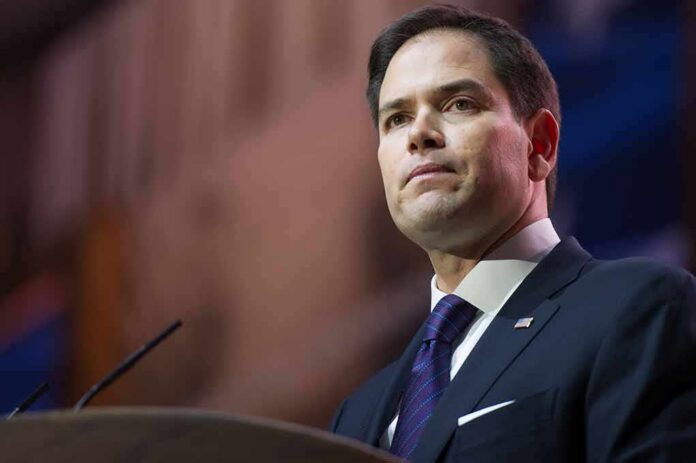
As Washington and Moscow trade barbs over Ukraine, Secretary Marco Rubio now says the United States wants a bigger hand in shaping how this war finally ends — while quietly admitting the earlier Anchorage track went nowhere.
Story Snapshot
- Rubio met Russia’s Sergei Lavrov in Manila and said the United States is ready to play a “constructive role” in ending the Ukraine war.
- The State Department describes a standing peace channel with “high-level teams” working on an “enduring, sustainable” settlement, not a dead process.
- Rubio admits there is “no quick path to a deal,” and past efforts have produced little real movement on the ground.
- Russia pushes to revive earlier Alaska terms, while the Trump administration seeks a deal that protects American interests and stops the bloodshed.
Rubio and Lavrov Meet Again as War Drags On
U.S. Secretary of State Marco Rubio met Russian Foreign Minister Sergei Lavrov on the sidelines of Association of Southeast Asian Nations meetings in Manila, with the Ukraine war dominating the agenda. Rubio told reporters the Trump administration is ready to help end what he called a “senseless war” but warned there is no fast or simple agreement coming. For conservative Americans tired of endless foreign wars and soaring costs, that mix of hope and caution feels very familiar.
The Manila session is only the latest contact in a long and often frustrating series of talks. Rubio has previously pressed Lavrov about Russian strikes on Kyiv and the stalled peace process, stressing that Washington wants serious progress, not photo-op diplomacy. Each round of talks matters because real peace could ease global energy prices and defense spending that hit American families through higher gas bills and tax burdens.
From Anchorage to Manila: A Troubled Peace Track
The earlier “Anchorage” effort grew out of a direct conversation between President Donald Trump and Russian President Vladimir Putin, followed by a formal meeting between Rubio and Lavrov. According to the State Department, both sides agreed to set up a consultation mechanism, name high-level teams, and “remain engaged” on a path to end the conflict in a way that is “enduring, sustainable, and acceptable to all sides.” That language shows Washington did not formally declare the effort dead, even as progress stalled.
Rubio’s more recent comments reflect that reality. In Manila, he said the United States is prepared to play a “constructive role” in bringing the war to an end if a real opportunity appears. Associated Press reporting quotes him saying diplomacy will take “sustained effort and new ideas,” which is a polite way of saying earlier paths have not delivered peace yet. For many on the right, this raises hard questions about past Western strategies that poured weapons into the region without a clear, achievable exit plan.
Competing Messages From Washington and Moscow
Official readouts from Washington and Moscow tell different stories. The State Department emphasizes teams, mechanisms, and a responsible push for an acceptable settlement. Russian statements, by contrast, stress that Moscow is ready to talk peace but on the basis of terms drafted earlier in Alaska that heavily favor Russian interests over Ukraine’s. That split shows why the process has bogged down and why any new American role must be rooted in strength, not wishful globalism.
Following his meeting with Russian Foreign Minister Sergey Lavrov at the sidelines of the ASEAN summit on Thursday, US Secretary of State Marco Rubio responded to the question about reports that Russia is providing intelligence to the Iranians allowing them to target American… pic.twitter.com/c8gEj4hZEQ
— Status-6 (War & Military News) (@Archer83Able) July 23, 2026
Rubio has also carried President Trump’s message of frustration over the lack of progress. After a previous meeting, he relayed Trump’s view that Russia has shown “insufficient flexibility” to stop the fighting and called for a clearer plan to resolve the conflict. Conservatives who back Trump’s America First approach can see the tension: the United States wants to stop the bloodshed and stabilize markets, but it must not cave to demands that reward aggression or drag America into another open-ended commitment.
What This Means for American Conservatives
For many readers, the core concern is simple: will this new diplomatic push end a costly war, or just repeat the same failed script? Rubio’s promise that the United States is ready to help broker peace sounds responsible, especially compared with the Biden-era habit of writing endless checks with no strategy. But the slow pace and vague language also show how easily elite diplomacy can drift away from clear U.S. interests and accountability.
As talks move beyond Anchorage and Manila, conservatives will want to watch three things closely. First, does any deal truly shorten the war and cut the risk of escalation, or does it lock in another frozen conflict that justifies more spending? Second, are American energy and security interests protected, including relief from war-driven price shocks at the pump? Third, does Washington respect constitutional limits, keeping Congress and the public informed instead of using secret channels? The answers will decide whether this diplomacy serves the American people or yet another globalist project.
Sources:
thegatewaypundit.com, reuters.com, state.gov, thehill.com, tass.com, it.usembassy.gov







![🇺🇸|🇱🇧 President Donald Trump Meets President of Lebanon Joseph Aoun at The White House [LIVE]](https://beyondnews.org/wp-content/uploads/sites/2/2026/07/maxresdefault-15-100x70.jpg "Oval Office Shock: Lebanon’s Leader Steps In")