

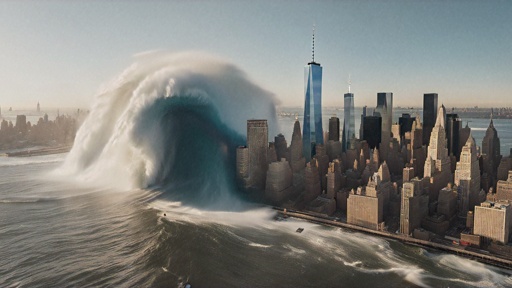
UNESCO says a tsunami in the Mediterranean is not a maybe, but a mathematical appointment somewhere in the next few decades—and the clock is already ticking.
Story Snapshot
- UNESCO’s ocean experts say there is a 100% chance of at least a one-metre Mediterranean tsunami within 30–50 years [3][5].
- Warning systems now watch the North-East Atlantic and Mediterranean around the clock, but coverage has gaps [5][7].
- Coastal cities are racing the calendar to become “tsunami ready” by 2030, with drills, maps, and sirens [6][8].
- The real question is whether governments and homeowners act before the wave, not after the headlines.
The Mediterranean’s Comfortable Illusion Of Safety
Tourists buy postcards of sunsets in Nice, Amalfi, and Santorini, not evacuation maps. Yet UNESCO’s Intergovernmental Oceanographic Commission, which runs the North-Eastern Atlantic and Mediterranean tsunami program, flatly states there is a 100% chance of a tsunami at least one metre high hitting the Mediterranean within 30–50 years [3][5]. That is not fringe activism; that is the official language of the United Nations ocean agency. The basin trails only the Pacific in recorded tsunamis, but public perception has not caught up.
Media outlets amplified that stark warning, quoting UNESCO officials as saying the odds are “100 per cent” in the next few decades [1][2][5]. That phrasing sounds almost theatrical, and skeptics latch onto it. They ask for equations, model assumptions, and error bars. The technical report behind the sound bite remains offstage in this material, which weakens the rhetorical certainty [3]. Yet the blunt message aligns with a simple, conservative principle: what has happened repeatedly in history will happen again.
How The Tsunami Warning Web Actually Works
The tsunami program for the North-East Atlantic and Mediterranean is not a think tank; it is a working safety net of sensors, national centres, and sirens. UNESCO describes its initiative as bringing together governments, warning systems, and coastal communities to tackle tsunami risk in that region [7]. France, Greece, Italy, Portugal, and Turkey serve as designated Tsunami Service Providers, issuing bulletins when earthquakes strike under the sea [7]. This is an operational network, not a white paper discussion group.
One recent example shows how quickly that machinery can move. The Better World Campaign reported that after a significant undersea tremor, UNESCO’s Intergovernmental Oceanographic Commission issued a tsunami alert within ten minutes [4]. For a basin where some coasts could see waves in under half an hour, that speed is not a luxury; it is survival margin. UNESCO openly frames early warning as a way to cut the death and destruction of catastrophic coastal hazards, not to eliminate the hazards themselves [4][8]. Sirens do not stop waves, but they can empty beaches before water arrives.
The Gaps No One Should Gloss Over
Officials like to describe the network as comprehensive, and to a point that is true. Yet technical documentation from the Greek national tsunami center states that the regional system currently operates only for tsunamis generated by earthquakes [5]. The same source admits that tsunamis caused by underwater landslides or volcanic processes lie beyond its present operational status [5]. That is an uncomfortable reality when many public discussions mention volcanic flank collapses and submarine landslides as serious Mediterranean threats.
The Greek centre does run a twenty-four-hour monitoring and alerting service for Greece and the eastern Mediterranean, issuing warnings to authorities when earthquakes hit [5]. That is good stewardship and lines up with a conservative view of government’s proper role: provide timely information and a functioning alarm, then let local officials and citizens act on it. But no one should pretend this equals full coverage of every plausible mechanism. The hazard catalogue is broader than the system’s current remit, and honest risk communication should say so plainly.
UNESCO’s 2030 Bet On Prepared People, Not Perfect Models
Instead of promising perfect prediction, UNESCO is betting on prepared communities. The organization launched a 2030 strategy for the North-East Atlantic and Mediterranean tsunami warning system, explicitly aimed at strengthening resilience along European and North African coasts [6]. The goal reaches beyond hardware to culture: evacuation routes, signage, exercises, and clear chains of command. UNESCO’s broader tsunami program describes this evolution as “preparing for the unpredictable,” emphasizing drills and community readiness as much as sensors [8].
UNESCO warns a tsunami in the Mediterranean is inevitable https://t.co/aGI9F7r8g4
— lima foxtrot (@LimaF429) May 21, 2026
That approach lines up with common-sense, limited-government instincts. No central planner can micromanage every harbour wall or living room. What a transnational body can do is set standards, connect warning centres, and nudge mayors and homeowners toward responsibility. If you own a shop on a low-lying beachfront, the lesson is not panic; it is a checklist. Know the siren tone. Know the uphill route. Know that when the sea suddenly drains away, you do not walk out to film it for social media.
Why The “100 Percent” Line Matters More Than Its Math
Critics focus on the statistical bravado of “100% chance” within 30–50 years, and they raise fair points. The public material here does not show the underlying hazard model or explain why the interval sometimes appears as 30 years and sometimes as 30–50 [1][2][3][5]. That ambiguity invites doubt. However, the core direction of the message remains grounded: the Mediterranean has a long tsunami history, a dense coastal population, and an active geological setting. Waiting for courtroom-grade certainty before preparing would be reckless.
American conservatives understand that you buy insurance before the house fire, not while it burns. UNESCO’s tsunami work plays a similar role on a coastal scale. The wave, when it comes, will not care whether bureaucrats overcooked a phrase in a press release. It will only care how many people knew the plan, where the sirens were, and whether local leaders treated a decades-long warning window as a chance to act or an excuse to drift. On that choice, the Mediterranean still has time—but not as much as it thinks.
Sources:
[1] Web – Mediterranean Mega-Tsunami? Experts Say It’s 100% Certain – Surfer
[2] Web – The vulnerable European city that is preparing a tsunami evacuation …
[3] Web – North-Eastern Atlantic and Mediterranean – IOC Tsunami – UNESCO
[4] Web – Wait… UNESCO Does What? The UN’s Surprising Role Leading …
[5] Web – Tsunami Warning Services – HL-NTWC
[6] Web – UNESCO launches strategy for tsunami resilience in the Atlantic and …
[7] Web – Tsunami risk mitigation and early warning systems … – UNESCO
[8] Web – Tsunami Warning System: Preparing for the unpredictable – UNESCO