

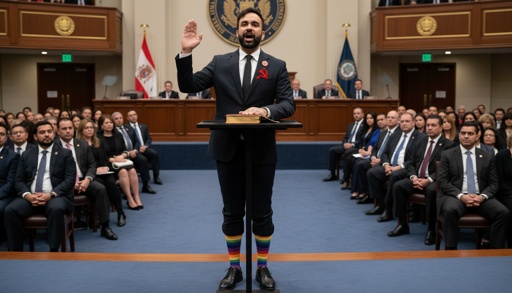
When Congress holds a hearing that sounds more like a warning label – “Sharia-Free America” – you are not just watching politics, you are watching a fight over who gets to define the rules of the American experiment.
Story Snapshot
- House Judiciary leaders say emerging Sharia-based institutions threaten the single constitutional rulebook. [1][3][4]
- Witnesses describe “parallel legal systems” and cite a blocked Texas Islamic enclave as a test case. [2][4]
- Critics counter that the hearings themselves flirt with punishing a faith, not protecting the Constitution. [2]
- The unresolved question: where private religious practice ends and unconstitutional civil authority begins. [4]
Congress Put a Spotlight on a Clash of Legal Systems
House Judiciary Republicans did not name this series of hearings “Sharia-Free America” by accident. The official notice framed the issue as whether “alternative, Sharia law-based legal and civic institutions” are taking root inside the United States and whether those institutions violate federal law and the Constitution. [1] That language signaled a specific fear: not that Muslims worship, but that some actors might build parallel authority structures that compete with the nation’s single, secular legal order.
Representative Chip Roy of Texas grabbed that framing and turned the volume up. In his press release, he argued that “the principles of Sharia are at odds with the Constitution and the laws of the United States,” charging that Sharia lacks due process, mistreats non-Muslims, and authorizes “barbaric punishments.” [3] In Roy’s account, Sharia does not just offer a personal moral code; it offers a rival legal project, a “foreign legal code” that some want to “force” onto American communities. [3]
The Texas Test Case: An Islamic Enclave That Never Happened
Republican members reached repeatedly for one dramatic example: a 402-acre development tied to the East Plano Islamic Center in Texas that they said was intended to be governed by Sharia. [4] They portrayed it as a prototype “Islamic enclave,” with its own institutions and an ambition to place Islamic jurisprudence above state and federal law. [4] Texas authorities blocked the project, and a prior federal civil-rights investigation eventually closed, but the full application and governance documents are not in the record here. [4]
That missing paper trail matters. If the project simply offered a residential community anchored by a mosque and voluntary religious arbitration, it would look similar to many faith-based developments and retreats across the country. If, instead, it attempted to exercise coercive authority over residents, or bind non-consenting neighbors to religious rules, it would cross a constitutional line. Conservative common sense says you do not condemn a church, mosque, or synagogue for existing; you scrutinize any claim to wield state-like power.
Parallel Courts, One Constitution, and the Line Congress Drew
One hearing witness, summarizing the constitutional heart of the problem, stated bluntly that the American system “does not recognize parallel sovereign systems operating outside constitutional supremacy, judicial review, equal protection, due process or the rule of law.” [4] The concern, he emphasized, “is not private worship or voluntary religious practice. It arises where systems attempt to establish coercive adjudicatory structures” while claiming immunity from constitutional accountability. [4] That is a crucial distinction many soundbites skip.
.@DailySignal: "Rep. Chip Roy, R-Texas, a member of the House Judiciary Committee, was another early voice calling out the SPLC.
"'This hearing builds on the important work that subcommittee began in December and follows serious DOJ charges involving fraud and money laundering,”…
— Rep. Chip Roy Press Office (@RepChipRoy) May 19, 2026
Under that framework, a Muslim business using a private religious arbitrator looks similar to a Christian or Jewish arbitration panel. So long as civil courts enforce only awards that comply with state law and basic rights, the Constitution remains supreme. The problem comes if any religious body claims the power to override American law, declare itself the true sovereign, or punish people with no real choice to opt out. No conservative should tolerate that, no matter which scripture is invoked.
Demographic Surge, Fiery Sermons, and the Threat Narrative
Republicans added fuel by citing demographic trends and provocative rhetoric. They noted that Texas’s Muslim population grew from about 115,000 in 2000 to over 300,000 by 2020 and that the state now has more than 300 mosques. They highlighted statements from Muslim leaders about expanding Muslim political power and, in some cases, sympathetic comments toward jihad or resistance abroad. [2] They also pointed to foreign funding from Qatar-linked entities for Texas schools and universities as evidence of external influence. [3]
Those facts, even if accurate, do not themselves prove the existence of a parallel legal order. Population growth is not a crime. Building more mosques is not an insurrection. Foreign money in universities raises legitimate national-security questions, but it is analytically separate from whether Sharia-based civil authority is operating on American soil. Conservative prudence requires separating what feels threatening from what violates the law. Otherwise, emotion replaces evidence, and genuine constitutional concerns get buried under culture-war fog.
Religious Liberty Advocates Fire Back
Critics at the hearings, including Amanda Tyler from the Baptist Joint Committee, flipped the accusation. She argued that the very premise of “Sharia-Free America” betrays constitutional values because Congress has no authority to decide which religions are compatible with American life. From her perspective, the problem was not creeping Sharia; it was a government body singling out one faith tradition for suspicion, which brushes against the First Amendment’s protection of free exercise and its ban on religious tests.
Even one of the legal experts aligned with Republicans conceded the basic rule: Sharia is incompatible with the Constitution if government tries to legislate it, just as legislating the Bible or Torah would be. [4] That concession reinforces a core American conservative position: civil law must remain neutral, and no sacred text gets drafted into the statute books as such. The Constitution already handles that through the First Amendment and the supremacy of federal law. Any new “anti-Sharia” statute that effectively punishes Muslims for private practice would risk becoming exactly the kind of state overreach conservatives usually oppose.
What This Fight Really Decides
The hearings left two unresolved questions hanging in the air. First, are there concrete, documented Sharia-based institutions in America that claim coercive civil authority beyond voluntary religious life? The record gestures at possibilities but does not yet show a robust parallel system. [1][3][4] Second, can Congress target the dangers of any foreign or religious legal code without targeting the believers themselves? That is the tightrope: defend one Constitution, without drifting into one-approved-religion politics.
The conservative answer should be both firm and disciplined. One nation, one Constitution, one civil sovereign: no parallel courts, no rival legal codes with real coercive power. [4] At the same time, every American, Muslim or otherwise, retains the right to live by their faith voluntarily, so long as they obey the same civil laws as everyone else. The real test of these Sharia hearings will be whether lawmakers hold that line, or cross it in the name of saving it.
Sources:
[1] Web – Why Political Islam & Sharia Law Are Incompatible with the U.S. …
[2] Web – Why Political Islam & Sharia Law are Incompatible with the U.S. …
[3] Web – Rep. Roy Leads Hearing Highlighting the Threat of Sharia Law in …