
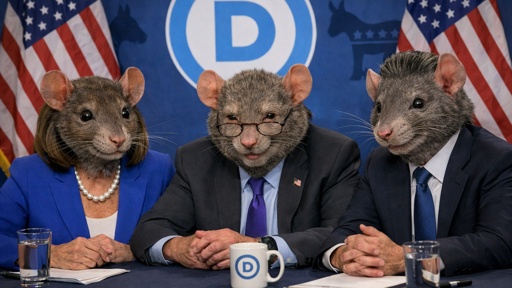
The Democratic Party’s internal fight is no longer being hidden, and the evidence shows a real split between its progressive and moderate wings rather than a neat public message.[1][3]
Quick Take
- Northeastern University says Democrats face a “growing divide” and a crisis of confidence.[1]
- Global Affairs reports persistent disagreements over fiscal policy, immigration, climate, defense spending, and other core issues.[3]
- Polling cited in the research shows many Democrats want the party to move more moderate, not more liberal.[7]
- The available record supports conflict and strategic tension, but not proof of a full party collapse.[1][2][3]
What the Split Actually Looks Like
Northeastern University commentary says the party faces a “growing divide,” with an “ideological rift between its progressive and centrist wings” that has produced a crisis of confidence.[1] The same analysis says Democrats may respond by shifting to more centrist immigration positions and more populist trade policies.[1] That points to a party trying to recalibrate after political setbacks, not a party that has settled its internal debate.
The policy disagreement is not abstract. A Global Affairs report says progressive and moderate Democrats have struggled to agree on fiscal policy, voting rights, immigration, and the Biden-era infrastructure fight.[3] The report also identifies recurring fault lines over climate change, defense spending, immigration, and American exceptionalism.[3] Even so, it notes that party leadership remains mostly moderate and that both wings still share some positions, including support for a path to citizenship for undocumented immigrants.[3]
Why Conservatives Should Pay Attention
Fox News opinion coverage frames the contest as a battle between the “moderate establishment” and “anti-establishment progressives,” with consequences for the party’s message and its 2028 nominee.[2] That matters because a fractured opposition can still become dangerous if it eventually unifies around a more aggressive regulatory, tax, and cultural agenda. The research also cites Gallup polling showing that more Democrats and Democratic-leaning independents prefer moderation than greater liberalism, which suggests the party base is not marching in one direction.[2][7]
From a conservative perspective, the larger point is simple: Democrats are arguing over whether to move left, move to the center, or blend both approaches into one coalition.[1][2][3] That kind of tension often exposes the weakness of a big-tent political machine built on competing activists, donors, and media factions. It also explains why public debate inside the party keeps returning to immigration, fiscal policy, climate policy, and trade rather than a single unifying message.[3][4]
What the Evidence Does and Does Not Prove
The strongest materials here document disagreement and strategic uncertainty, not organizational collapse.[1][3][4] The sources do not provide voter-file analysis, turnout data, or primary-to-general-election evidence showing that the progressive-moderate divide is costing Democrats seats on its own.[1][3] They also do not isolate this split from other factors such as candidate quality, inflation, foreign policy, or media coverage. That limits how far anyone can go in claiming the party is in a true civil war.
Even so, the public argument is real, and it is now visible enough to shape messaging, fundraising, and candidate recruitment.[2][4] Divided We Fall describes the issue as a choice between prioritizing progressives or moderates, while Northeastern describes a growing divide that may force a strategic reset.[1][4] For readers tired of elite political games, the broader lesson is that Democrats are still fighting over the basic terms of their own coalition.
Sources:
[1] Web – The Imminent Democrat Party Civil War
[2] Web – Can progressives and moderates bridge the growing divide in the …
[3] Web – Democratic battle pits moderates vs. progressives for soul of the …
[4] Web – [PDF] Liberal and Moderate Democrats: How Different Are They in Views …
[7] Web – The Progressive/Moderate Battle in the Democratic Party