

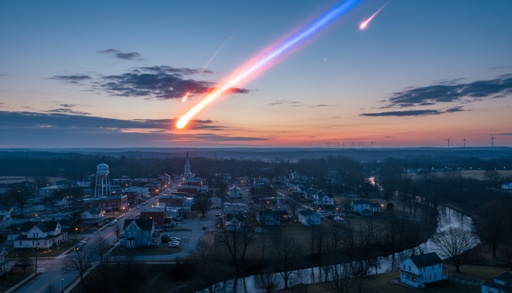
A mysterious boom that shook homes from Boston to Rhode Island turned out not to be terrorism or a secret weapons test, but a three‑foot space rock breaking apart high over New England.
Story Snapshot
- A roughly three‑foot meteor exploded high above New England, creating a sonic boom that rattled homes and nerves across several states.
- NASA estimates the blast energy at about 300 tons of TNT, with fragments likely falling into Cape Cod Bay about 100 feet underwater.[1][3]
- Residents initially feared anything from a chemical plant disaster to a military incident, highlighting widespread distrust in official communication.[2]
- The event exposes how dependent Americans are on government and elite institutions for basic information about phenomena that can directly affect their safety.[1][2][3]
What Actually Happened Over Massachusetts
On a clear Saturday afternoon, around 2:11 p.m. Eastern Time, residents from northern New England down to southern Rhode Island reported a sudden explosion-like boom that rattled windows, shook homes, and sent people scrambling for answers.[1][2] The United States Geological Survey quickly ruled out an earthquake, and there were no reports of industrial accidents or military exercises that could explain the shockwave.[2] Confusion spread as emergency services and newsrooms were flooded with calls describing an eerily similar experience.
Later that day, data began to point skyward. Weather radar and satellite lightning sensors detected a brief flash in an area where there were no thunderstorms, matching the signature of a so‑called “bolide,” a meteor that explodes in the atmosphere.[1][2] NASA subsequently confirmed that a roughly three‑foot object traveling about 75,000 miles per hour entered over the Massachusetts–New Hampshire border, fragmented at roughly 40 miles altitude, and produced a powerful sonic boom.[1][3] That pressure wave was the “bomb‑like” sound people heard on the ground.
How Powerful Was The Blast — And Where Did It Land?
NASA estimated that the meteor’s breakup released energy comparable to roughly 300 tons of TNT, an amount large enough to rattle structures across a wide area but far short of a city‑destroying impact.[1] According to NASA’s reconstruction, the object fragmented high over northeast Massachusetts and southeast New Hampshire, then continued on a path that led debris toward the ocean.[1][3] Officials believe any surviving fragments likely fell into Cape Cod Bay, in water about 34 meters, or roughly 100 feet, deep.[1][3] Recovery would require specialized magnetic search equipment.
Scientists described the event as a daytime “fireball” or “bolide,” part of a known pattern where larger space rocks occasionally penetrate deeper into the atmosphere before disintegrating.[1][2] Most meteors burn up harmlessly and go unnoticed, but bigger ones can generate the blinding flashes and sonic booms that grab public attention.[1] Statistically, experts say it is extremely unlikely for a meteorite to strike a person, and current research indicates no immediate impact threat to Earth from similar objects on known trajectories.[1] That scientific reassurance contrasts sharply with the anxiety many residents felt during the unexplained boom.
Why The Confusion Fed Public Distrust
In the first minutes and hours after the boom, ordinary people had almost no real-time information about what had shaken their homes, a vacuum that invited speculation about explosions, terrorism, or military accidents.[2] Local meteorologists and reporters did much of the early investigative work, checking seismic data, radar, and satellite signatures while federal agencies remained cautious and slow to confirm details.[1][2] For Americans already skeptical of government transparency, the delay fit a familiar pattern where citizens feel the last to know about events that directly affect them.
A meteor explosion startled New England on Saturday. See how this dog, Chicken, responded to the boom https://t.co/ZBy5RinLnD
— Providence Journal (@projo) June 1, 2026
Many on both the right and the left see this kind of episode as another reminder that the country’s vast scientific and security apparatus is controlled by distant elites who rarely explain themselves clearly. Conservatives, already wary of federal agencies they associate with politicization, and liberals, frustrated by what they view as corporate and governmental secrecy, share a growing sense that institutions talk down to them. This meteor was natural, not political, yet the communication gaps around it still reinforced the belief that ordinary people are kept in the dark until experts choose to speak.
What This Space Rock Says About Risk, Preparedness, And Power
This New England airburst was not a doomsday event, but it illustrates how fragile public confidence has become. A three‑foot rock from space exposed how dependent Americans are on a handful of agencies and contractors to track, interpret, and explain threats they cannot see. When those gatekeepers are slow, vague, or inconsistent, people with long memories of failed promises on everything from border security to inflation naturally question whether they are getting the full story, even about something as apolitical as a meteor.
At the same time, the rapid forensic work shows what modern technology can do when properly used. Radar, satellite data, and global monitoring networks turned a mysterious blast into a mapped and measured event within roughly a day.[1][2] The deeper issue is not the science but the relationship between institutions and citizens. In a political era where many believe the federal government serves itself before the people, even a harmless space rock becomes a test of trust. How leaders handle the next unexplained boom may matter as much as what caused it.
Sources:
[1] Web – A meteor causes loud boom as it enters atmosphere and breaks apart …
[2] Web – Meteor above New England created loud boom that rocked …
[3] Web – Meteor explodes off coast of Massachusetts, causing loud …