

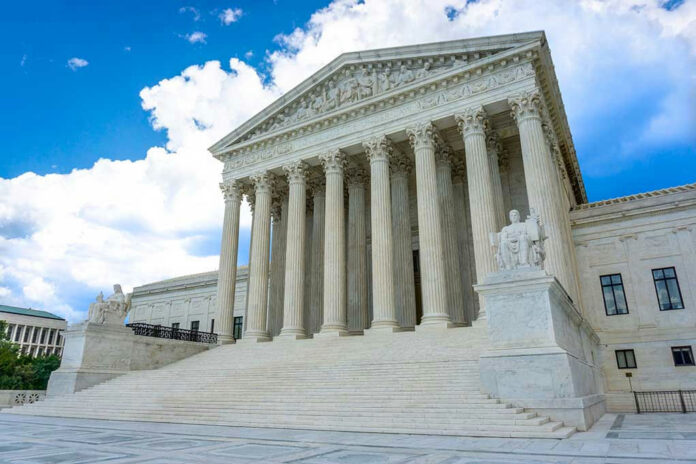
The Supreme Court just handed President Trump a sweeping win on immigration, ruling that federal judges can no longer second‑guess most decisions to end “Temporary” Protected Status.
Story Snapshot
- Supreme Court says courts generally cannot review the decision to grant or end Temporary Protected Status, locking key power back in the elected branches.
- Trump administration can now move forward on ending TPS for Venezuelans, Haitians, Syrians, and others after years of activist court delays.
- Liberal justices and advocacy groups call it a “devastating” ruling, but the majority says TPS was never meant to be a backdoor amnesty program.
- The decision could affect more than 1 million people and marks a major rollback of judicial overreach on immigration.
Supreme Court Restores Executive Power Over TPS
The Supreme Court’s conservative majority has now clearly said that when Congress gave the Homeland Security secretary power over Temporary Protected Status, it meant it. The Court held that the TPS law sharply limits what judges can review, and that courts cannot step in to second‑guess the secretary’s call to end or extend protections.[4] This follows an earlier emergency order that let the Trump team restart its plan to end the 2023 TPS grant for about 350,000 Venezuelans.[2]
Justice Samuel Alito, writing for a 6–3 majority, stressed that immigration choices tied to foreign policy and national security belong mainly to the elected branches, not to unelected judges.[4] The Court said TPS decisions are “not subject to judicial review” in most cases, closing the door on years of lawsuits that tried to turn a short‑term program into a permanent foothold. Critics call this “de‑legalization,” but the ruling simply enforces the word “temporary.”[5]
How Trump’s Team Used the Ruling to Unwind Biden’s TPS Expansions
When President Joe Biden left office, people from 17 countries had TPS, including large groups from Venezuela, Haiti, Syria, Afghanistan, and others.[19] Since returning to office, President Trump and Homeland Security Secretary Kristi Noem have moved to end or attempt to end TPS for 13 of those countries, affecting more than a million people.[19] For Venezuelans, Noem canceled Biden’s 2023 expansion that had covered about 350,000 people and rolled their end date back from October 2026 to April 2025.[18]
Lower‑court judges, led by Judge Edward Chen on the West Coast, tried to block those moves and accused the administration of acting too fast and without enough proof.[2] A unanimous panel of the Ninth Circuit Court of Appeals even said Noem had overstepped by undoing a prior extension and claimed the TPS framework was insulated from politics.[8] The Supreme Court swept those orders aside, first with an emergency stay in the Venezuela case,[17] and now with a broad ruling that says judges may not relitigate the secretary’s bottom‑line TPS call.[4]
Left‑Wing Attacks: “Racial Animus” and “Devastating Moment” Claims
Immigration activists and liberal media reacted with fury. The American Immigration Council accused the Court of “de‑documenting” 350,000 Venezuelans and warned the decision could lead to mass deportations.[10] Other critics blasted the ruling as the “biggest de‑legalization moment in modern history” and a “devastating moment for this country,” framing Trump’s policy as cruel rather than lawful enforcement.[9] Some advocates tie the TPS rollbacks to a wider push to crack down on both legal and illegal immigration.[7]
The Supreme Court correctly ruled that TPS is temporary, not a backdoor to permanent residency.
Holders from countries like Haiti and Venezuela were never meant to stay indefinitely after conditions improved or the designation expired. They registered and worked legally under…
— Liberal Tear Drinker (@DrinksLibTear) June 25, 2026
Lawyers for TPS holders argue that Noem and Trump acted out of racial bias, pointing to past tough language about migration from crisis‑hit countries.[8] Liberal justices Sonia Sotomayor and Ketanji Brown Jackson suggested during arguments that racial hostility might be behind some terminations.[3] But those claims remain unproven allegations, not findings of fact, and the majority still held that courts cannot turn such accusations into open‑ended reviews of every TPS decision.[4]
What This Means for Borders, States, and the Constitution
This decision gives Trump’s administration a much freer hand to wind down what has become a sprawling, decades‑long patchwork of “temporary” statuses. Policy groups note that as of early 2026, the administration has already ended or moved to end TPS for Afghanistan, Cameroon, Honduras, Nepal, Nicaragua, and certain Venezuelan groups, with Yemen and others slated next if courts do not intervene.[19] The ruling also green‑lights ending TPS for Haiti and Syria, potentially affecting hundreds of thousands more.[4]
Some sanctuary states are signaling they will resist federal efforts to remove people who lose TPS, setting up more fights between local politicians and Washington.[2] For conservative readers, the core issue is simple: who sets immigration policy, elected leaders or activist judges and state officials. By reaffirming that Congress and the president control TPS, the Court has pushed back against years of judicial overreach and reminded everyone that “temporary” cannot secretly mean “forever.”[4]
Sources:
[2] Web – Supreme Court allows Trump to revoke immigration protections for …
[3] Web – Supreme Court will hear Trump’s bid to end legal protection for up to …
[4] Web – Supreme Court Grapples With Trump’s Plan to Revoke Deportation …
[5] YouTube – Supreme Court weighs effort to end temporary protective status for …
[7] Web – Supreme Court: Here are the cases that are still to be decided – NPR
[8] Web – Supreme Court weighs Trump bid to end protections for migrants
[9] Web – Appeals Court Blocks Trump Administration from Ending TPS for …
[10] Web – BREAKING: TPS Holders and Advocates Denounce Supreme Court …
[17] Web – Noem v. National TPS Alliance (Venezuelan TPS Termination)
[18] Web – End of Temporary Protected Status: 2025 Termination
[19] Web – Fact Sheet: Termination of Temporary Protected Status for Haiti