

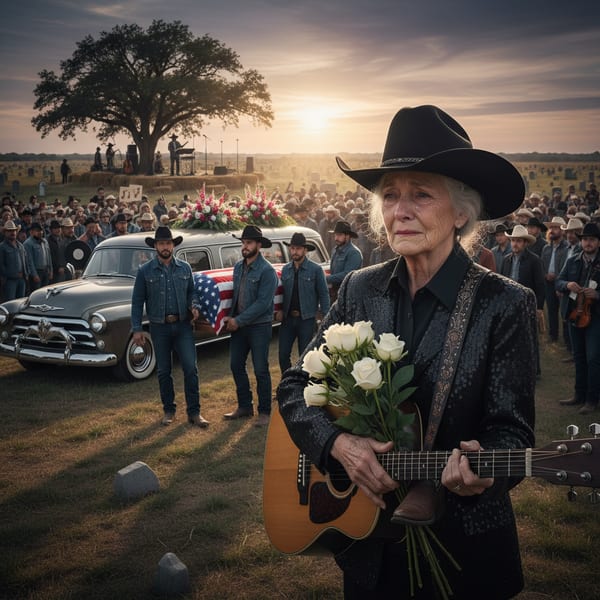
David Allan Coe, the outlaw country pioneer who stood alongside Willie Nelson and Waylon Jennings while penning some of country music’s most enduring hits, has died at age 86.
A Songwriter’s Legacy Beyond Performance
Born in Akron, Ohio, Coe achieved fame as a performer with jukebox staples like “You Never Even Called Me by My Name” and the poetic “The Ride” from his 1983 comeback album “Castles in the Sand.” His songwriting talents reached even further. Coe wrote “Take This Job and Shove It,” the working-class anthem Johnny Paycheck made famous. When people forgot Coe penned the hit, he recorded his own version in 1980 as a direct response to Paycheck. The Dead Kennedys later covered the original, proving Coe’s songwriting resonated far beyond Nashville.

Read more here >> go.countryrebel.com/DavidAllanCoeD…

Unlikely Collaborations With Rock Legends
Coe’s influence crossed genre boundaries in unexpected ways. Dimebag Darrell of Pantera told Guitar World in May 2000 that Coe represented country music’s equivalent to heavy metal’s rebellious spirit. After meeting backstage, the two struck up a friendship that led to Dimebag playing on Coe’s metal-country crossover album. “He called me up a day later and said, ‘Hey, Dime. It’s David Allan Coe. I’m gambling, and I just hit $50,000 on a slot machine. I want you to play on my new record,'” Dimebag recalled. Warren Haynes, who later found fame with the Allman Brothers Band and Gov’t Mule, got his first serious professional break touring with Coe, describing the experience as “frightening” due to the biker-heavy crowds and chaotic environment.
From Reform School To Country Music’s Fringe
Coe’s troubled upbringing shaped his outlaw persona. Placed in reform schools at age nine after growing up with an alcoholic father and violence at home, he spent much of his youth in institutions. “Being in institutions at that young age, I had to be very tough,” Coe explained in a 2003 interview. “A lot of people were always saying to me, ‘Smile.’ I say, I don’t smile. It ain’t what I do.” Despite his rebellious image and controversial lyrics that drew accusations of racism, Coe longed for mainstream acceptance. He served as a Country Music Association member for 35 years but was never invited to present at their award show, a slight that clearly bothered him.