

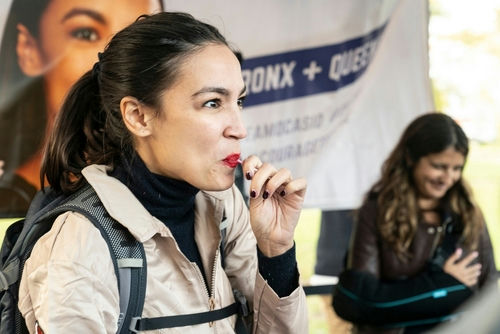
A flippant “Wah wah wah” from Alexandria Ocasio-Cortez over Virginia’s redistricting fight has turned into Exhibit A of how both parties talk about “democracy” while quietly gaming the system for themselves.
Virginia’s Redistricting War Exposes a Bigger Problem
Virginia’s latest redistricting clash began when a Republican-appointed judge threw out a Democratic-backed referendum that would have reshaped how the state draws its congressional map. Democrats had sold the measure as a fairness fix, but critics said it quietly tilted the process in their favor, potentially turning a closely divided state into a near Democratic lock. The ruling did more than freeze a map; it reopened a national argument about who really controls elections—voters, or entrenched political insiders.
That question matters beyond partisan scorekeeping. After the 2020 census, Virginia had adopted a bipartisan commission, praised by Democrats at the time as a model of good government. When the commission deadlocked, two experts drew a map that gave each party opportunities without guaranteeing either a stranglehold. Once Democrats saw they could possibly squeeze out far more seats under a new structure, many of those earlier “principled” arguments about neutral commissions suddenly faded into the background.
AOC’s “Wah Wah Wah” Moment and What It Reveals
Against that backdrop, AOC’s viral comments landed with a thud. Asked about Republican complaints that the voided referendum undermined voters, she mocked them with “Wah wah wah” and accused the GOP of a decade-long campaign of gerrymandering in states like North Carolina and Texas. She argued Democrats are now simply “fighting back” under rules Republicans created, insisting they have tried unsuccessfully to ban partisan gerrymandering while Republicans blocked reform bills in Congress.
Her argument contains a kernel of truth: Republicans did aggressively use their post-2010 control of state legislatures to shape maps across the Midwest and South, and they defended many of those maps in court. Yet her tone and timing undercut the moral high ground Democrats have claimed for years. After spending a decade preaching about “fair maps” and “protecting democracy,” leading Democrats in states like Virginia, Illinois, and New York have embraced the same partisan cartography when it promises them near-permanent advantages.
How Both Parties Turn “Reform” Into a Power Grab
Political analyst Michael Barone distilled this dynamic bluntly by saying all redistricting reformers are hypocrites. His point is that the loudest advocates for neutral rules often abandon those principles when they start cutting against their own side. Virginia Democrats championed the bipartisan commission when it looked like the best way to constrain Republican power. Once the political geography shifted and Democrats saw a path to a 10–1 or similar delegation, suddenly “revisiting” the system became a priority.
Republicans have their own version of this double standard. In states like Tennessee and Missouri, GOP legislators sliced up metro areas such as Nashville and Kansas City to dilute Democratic strength, even while railing against blue-state gerrymanders. Each side points to the other’s worst abuses, then asks voters to ignore identical behavior at home. For ordinary citizens—conservative, liberal, or somewhere in between—that pattern reinforces a grim conclusion: the mapmakers care more about protecting careers than ensuring communities have honest representation.
Deepening Distrust in a System Run by Elites
The rhetoric surrounding these fights makes the distrust worse. House Democratic Leader Hakeem Jeffries promised “maximum warfare, everywhere, all the time” if Florida Republicans advance maps he considers illegal. That language mirrors the scorched-earth talk many Republicans used when defending their own gerrymanders. Instead of reassuring voters that rules will be followed and the process will be transparent, national leaders turn redistricting into another battlefield where whoever holds power squeezes every possible inch from the map.
For Americans watching Washington and state capitols, this looks less like democracy and more like a cartel dividing territory. Conservatives angry about woke policies, porous borders, and runaway spending see political lines being redrawn to cement those same priorities. Liberals upset about corporate power and inequality see their own leaders talking reform while scheming for safe seats. The shared perception is that a small class of political professionals—staffers, consultants, donors, and elected officials—treats voters as numbers to be managed, not citizens to be served.
AOC's Embarrassing Remarks on Redistricting Show Just How Hypocritical Dems Arehttps://t.co/ew5dIjynVs
— RedState (@RedState) May 18, 2026
In that sense, AOC’s “Wah wah wah” remark is less an outlier than a slip of the mask. It signals how casually many in Washington now talk about foundational rules of representation. When the people drawing district lines mock concerns about legitimacy, they feed the belief that the deep state and party elites will always rig the game. For conservatives who value limited government and equal treatment under the law, the answer is not to out-gerrymander the other side, but to demand rules that neither party can bend in the dark.
Sources:
All redistricting reformers are hypocrites